The contamination shock when buying a home: When DinGeo sounds the alarm and what you really need to know
Imagine this: after months of searching, you've finally found your dream house in Denmark. The location is perfect, the price is right. Before you call the realtor, you enter the address into DinGeo and suddenly everything turns red: high risk for radon, asbestos, PCB, and lead contamination.
Your first impulse? Panic. Your second? Cancel the purchase immediately.
But before you bury your dream of homeownership, it's worth looking behind the numbers. Back then, I asked myself: "How relevant are these findings really? Some things I can see with my own eyes, but what about the hidden contaminants?"
Here's the information you need to overcome this "data shock" and professionally manage contamination risks.
1. Statistics are not measurements: The secret behind the scores
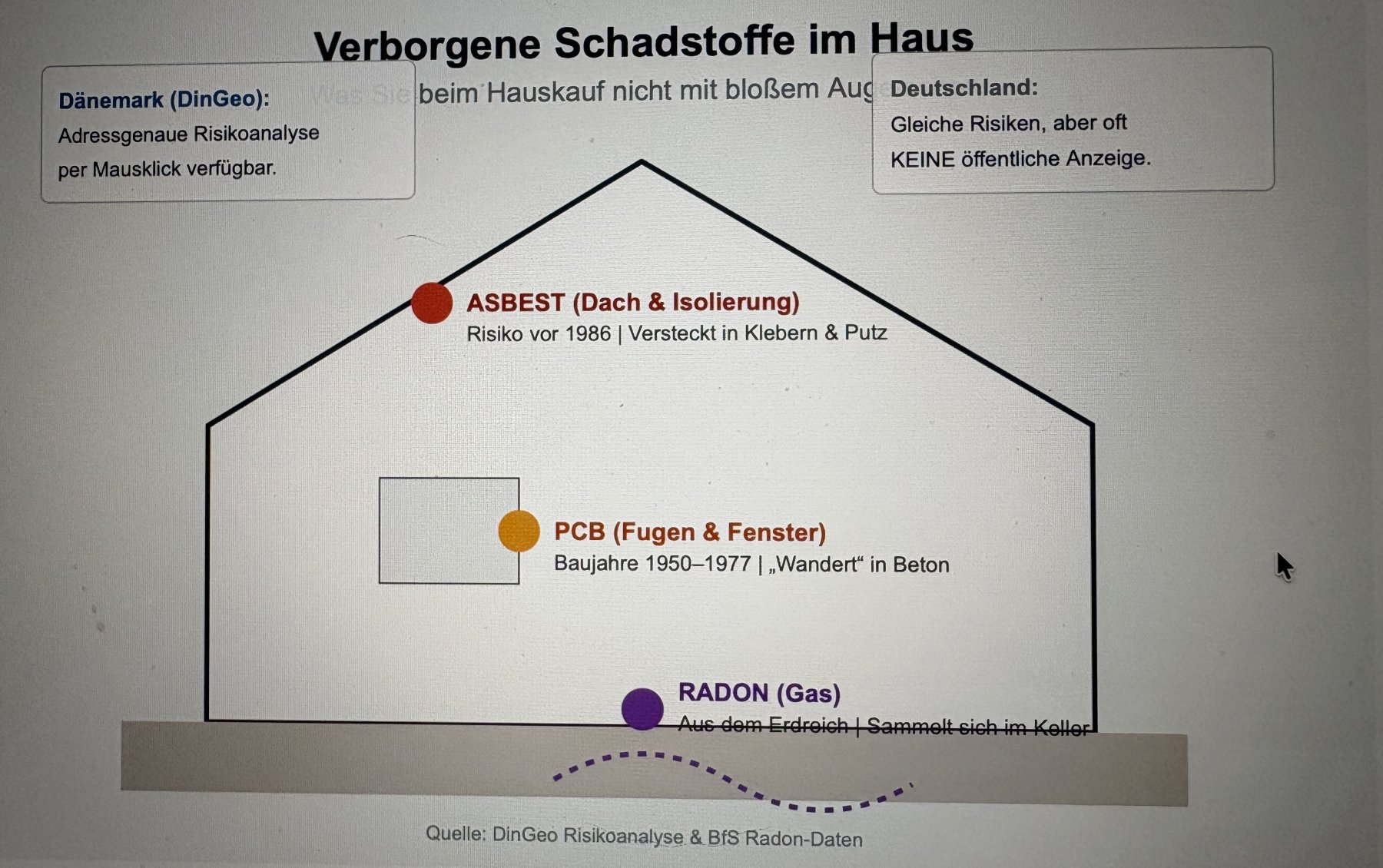
First, the most important message: a high risk score on DinGeo doesn't necessarily mean your potential house is contaminated. The platform uses an algorithm (developed by the engineering firm NIRAS) based on machine learning. The model was trained on thousands of real inspection data and links this with data from the Danish Building and Housing Register (BBR). When DinGeo shows "red," it simply means: houses from this construction year, with these materials, in this region statistically had contamination very frequently in the past. It's a screening tool, not a laboratory test.
2. The "Big Three" of invisible hazards
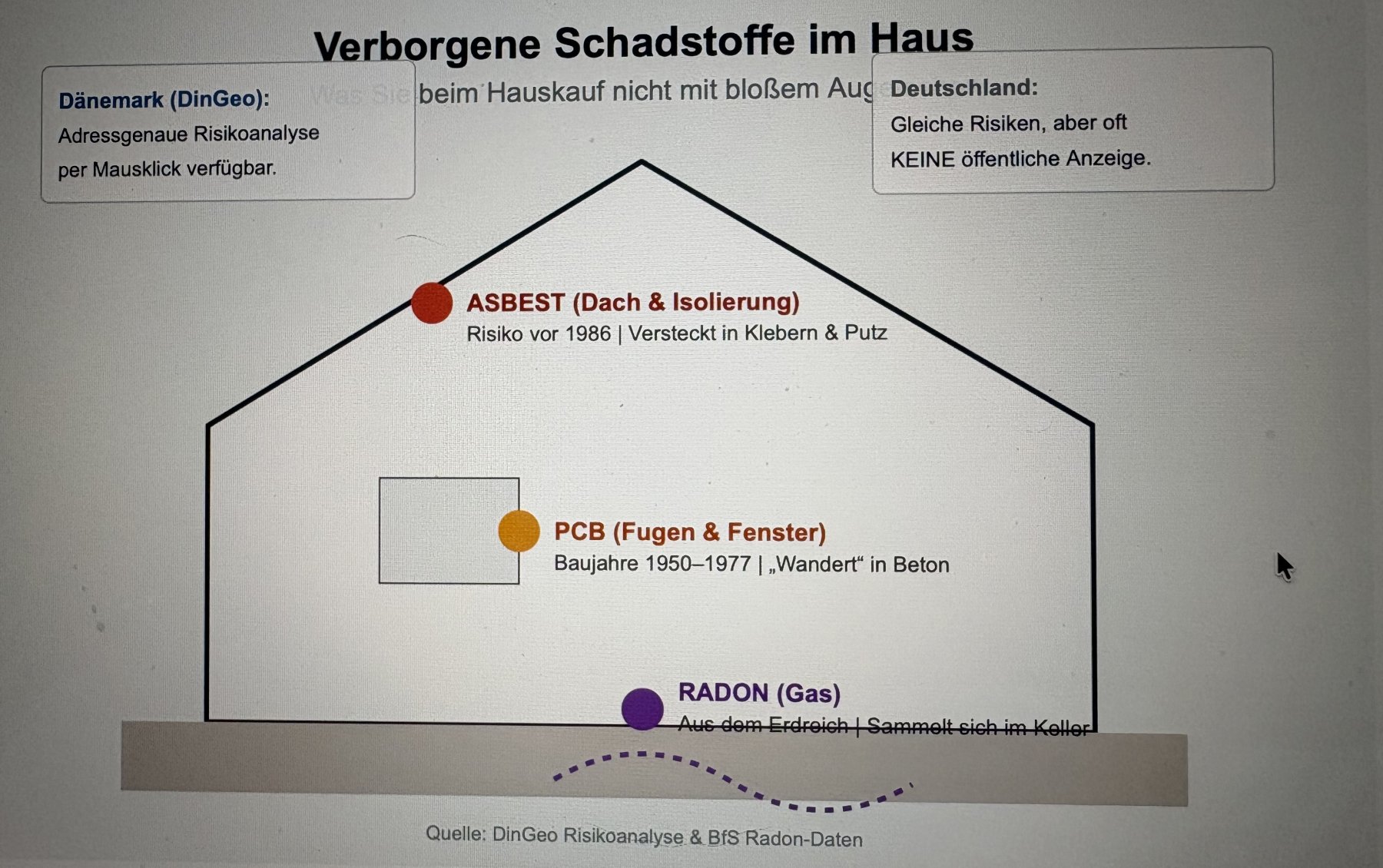
Radon: The danger from below Radon is a radioactive gas that seeps completely odorless from underground into your house. In Denmark, it's the second leading cause of lung cancer after smoking.
- Relevance: Particularly high in areas with certain soil types (e.g., moraine clay).
- Protection: Houses built after 1998 usually have radon barriers. For older houses, there are quick tests that provide initial results within 48 hours.
Asbestos was the game changer in 2025
While you can often spot an old asbestos roof, asbestos hides in tile adhesives, pipe insulation, or windowsills.
- Important for buyers: Since January 1, 2025, Denmark has extremely strict new rules.
- Asbestos removal work may only be carried out by authorized specialist contractors.
- This means: what you might have done yourself in the past will be significantly more expensive in the future.
- A house with asbestos risk is now a property with built-in renovation costs as of 2025.
PCB: The "wandering" poison
PCB was often used in sealants and window caulking between 1950 and 1977. The problem: PCB doesn't just off-gas; it also migrates into neighboring materials like concrete or wood (secondary contamination).
- Relevance: During renovation, it's often not enough to just replace the sealant; the adjacent masonry often needs treatment too.
3. Strategies for the buyer: How to protect yourself
Unfortunately, you can't see hidden substances. So you should use two things:
1. The lawyer's reservation (Advokatforbehold): never sign the purchase agreement without this clause. It usually gives you 3 to 6 business days to review the documents (and contamination risks). During this time, you can commission a professional environmental screening (costs approximately 5,000 - 12,000 DKK).
2. Targeted measurements: if DinGeo raises an alarm, demand that the seller provide measurements or permission for you to take your own sample (e.g., a radon quick test).
4. And what about insurance? The Danish Ejerskifteforsikring (ownership transfer insurance) is a blessing, but often has gaps when it comes to contaminants. It generally only covers "damage" that impairs the function of the house. Contaminants that met the state of the art at the time (like asbestos in the 70s) are often not considered an insurable case, unless they were incorrectly described in the condition report.
A glance across the border: And in Germany? This is where it gets particularly interesting for many readers: contaminants don't stop at the border. In Germany, properties built between 1950 and 1990 face exactly the same hazards: asbestos in storage heaters or floor coverings, PCB in the joints of public buildings, and radon in many regions of the Central German Uplands.
The big difference: Germany doesn't yet have an equivalent to DinGeo. While Danish buyers can get a statistical risk analysis for each individual house at the click of a button, German buyers usually have to buy blind or commission expensive expert reports at their own expense. For example, the radon maps from Germany's Federal Office for Radiation Protection are very rough and don't allow conclusions about individual buildings.
When you buy in Denmark, you're often frightened at first by the transparency of platforms like DinGeo. But this transparency is a strength! It allows you to name risks, renegotiate prices, and take health precautions. In Germany, you often buy "blind," but in Denmark you have the data to make informed decisions.