Lucia Festival - Light in the Danish Winter
December 14, 2025
December 13th is considered the day of light in the middle of winter.
The Lucia Festival is a custom with Christian roots that goes back to the feast day of Saint Lucia. It is particularly widespread in Sweden, but is also celebrated in Denmark, Norway, among Swedish-speaking Finns, and among Danish South Schleswig residents. The festival falls on December 13th, the feast day of Saint Lucia. In Sweden, before the introduction of the Gregorian calendar in 1752, this day was the shortest day of the year for more than a century and thus coincided with the winter solstice.
Whether the Lucia Festival in its form today widespread in Sweden actually has a direct connection to the historical Saint Lucia cannot be answered with certainty. On one hand, the festival owes its special significance to the fact that December 13th was long considered the darkest day of the year. The central motif of light fits seamlessly into other winter and Christmas customs, such as the Christmas tree or the Advent wreath. The Lucia Festival also gained its nationwide distribution less as a church holiday, but rather as a lived tradition.
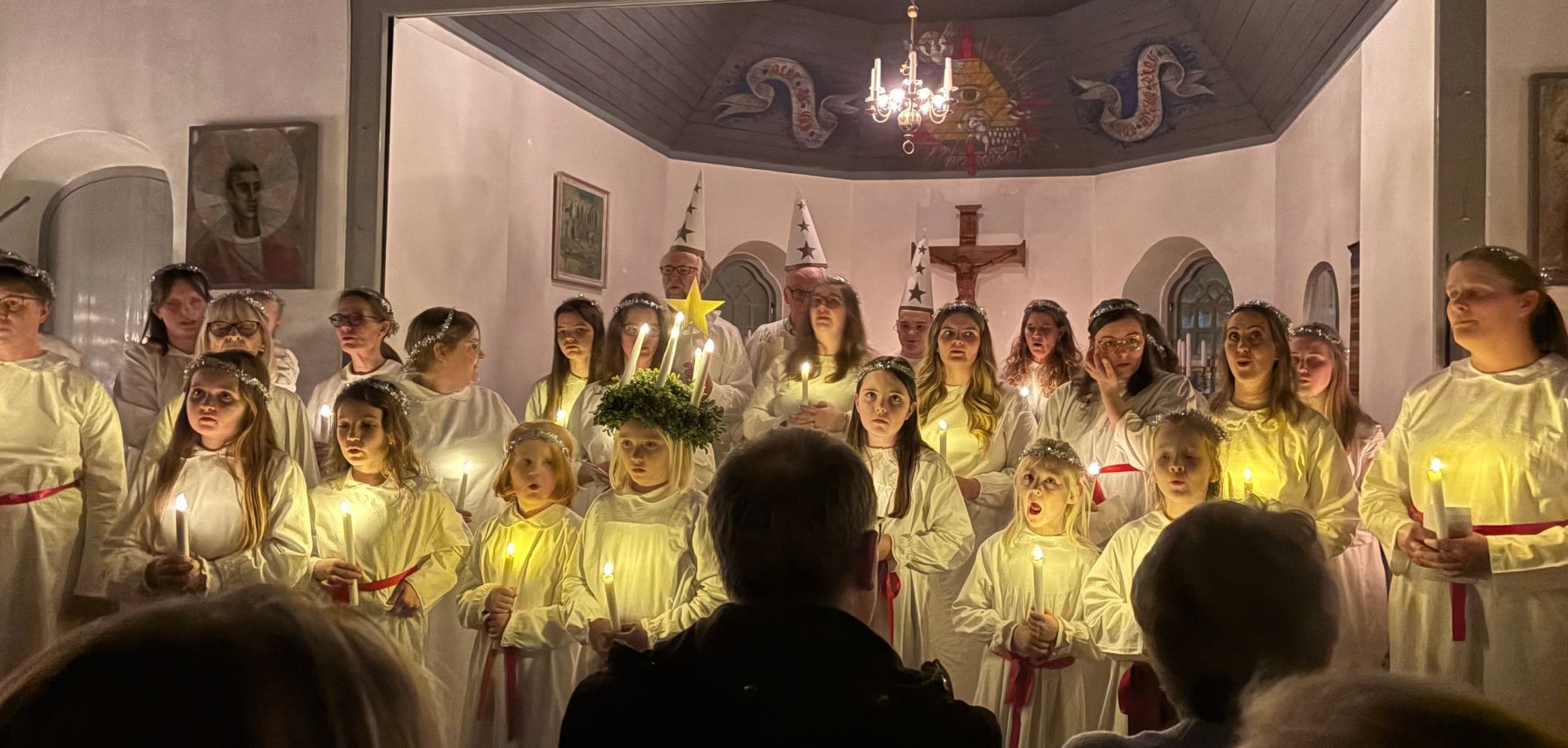
On the other hand, there are clear references to the legend of Saint Lucia. According to accounts, she wore a wreath of candles on her head in order to keep her hands free when secretly providing persecuted Christians with food. The white garment with the red band tied around the waist can also be interpreted symbolically: as a reference to Lucia's Christianity, her membership among the consecrated virgins, and her death as a martyr. According to tradition, Lucia had vowed celibacy for Christ's sake and died by a dagger thrust to the throat.
In this interpretation, the white dress stands for her virginity, the red band for her martyrdom.
Even today, the Lucia Festival is above all one thing: a custom that brings light into the winter. And yet I don't experience the Danish winter as dark at all. Quite the opposite: wherever I go, it is bright. Since November 1st, the streets have been decorated, candles glow everywhere. For six weeks now, the houses have been festively decorated. When you walk through the streets in the evening, or simply in the darkness, you are greeted by a warm, usually amber-colored light. It glows, it warms, and it makes me happy in a quiet way.
Here in Denmark, at least here in the far north, we bring so much light and so much warmth into our everyday lives that the one and a half hours of daylight we lack in winter is completely compensated for. We don't lack light in our daily lives. The warmth, the joy, and the many lights that shine everywhere give us a good, secure feeling.
The Lucia Festival last evening in Skagen was a wonderful example of this. The occasion was the hundredth birthday of the Seamen's Church. For this special anniversary, women and girls who had served as Lucia in recent years were invited. There were so many Lucias! An impressive and radiant procession, accompanied by traditional songs. A moment full of light, community, and deep warmth in the middle of winter.