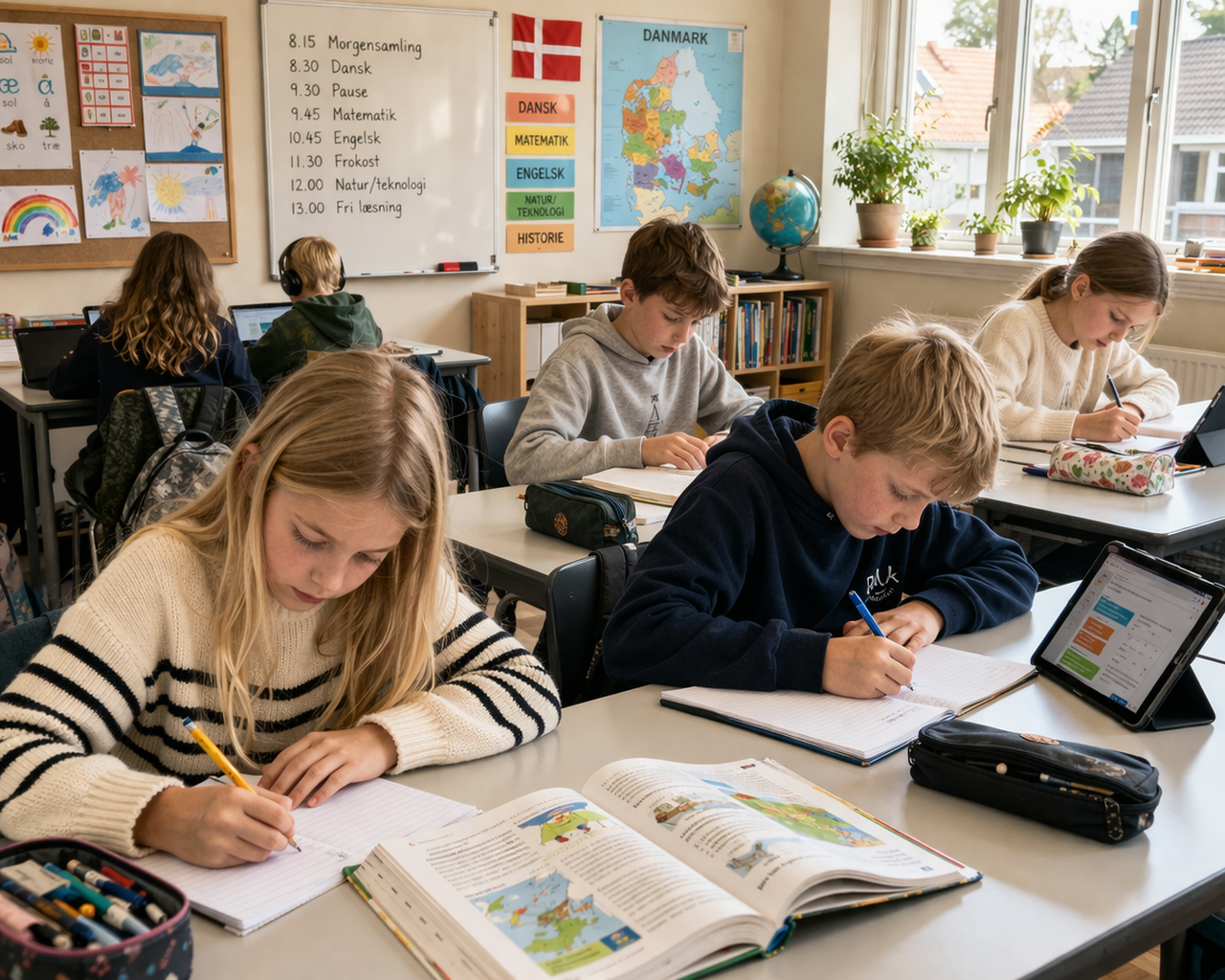
When families with children move to Denmark and wonder whether life outside the state school system is possible there, they quickly discover: this country has one of Europe's most liberal educational traditions. And this isn't just empty talk—it's anchored in the constitution. Section 76 of the Danish Constitution guarantees the right to home education—Hjemmeundervisning—and makes clear what sets this country apart from many of its European neighbors. In Denmark, there is no compulsory schooling. There is compulsory education. That's a difference!
The legal framework shows that this freedom comes with responsibility Danish law sets just one central condition for homeschooling: the instruction must correspond to what is generally required in the Folkeskole, the Danish public school. Not how it's taught, only what should be achieved in the end. This distinction is crucial because it allows enormous pedagogical flexibility without leaving education to chance. The bureaucratic hurdles are manageable.
You simply register homeschooling with your local municipality. No permission is required. The municipality is then obligated to supervise the instruction. This is called Tilsyn.
How this supervision looks in practice varies considerably from municipality to municipality. Often a municipal supervisor visits the family once a year for a conversation or a brief informal test. In some municipalities this runs very smoothly, while others have stricter documentation requirements, especially since the number of homeschoolers has grown significantly since the pandemic.
Another important aspect: children educated at home don't have to take the state final exams, the Folkeskolens Afgangsprøve. However, if they later want to attend gymnasium, they must typically retake these exams as external candidates or pass a separate entrance exam. This isn't an insurmountable obstacle, but it's worth considering.
Unschooling and Homeschooling: What's legally possible Danish law doesn't distinguish between structured homeschooling and free unschooling. So if you want to follow your child's interests, if you understand learning as something that emerges from life itself rather than curricula, Denmark offers good conditions. Since the law focuses on outcomes—on the child's knowledge and development rather than method—unschooling is very workable. What matters is that parents can credibly demonstrate during the annual supervision visit that the child is making progress.
Many families use this freedom to focus on practical life skills, nature, and social projects. This isn't coincidental: in Danish pedagogy, these elements have held high value for decades. When you let your child learn outdoors, when you center practical, creative, or social skills, you're not operating at society's margins—you're part of a long pedagogical tradition.
But let's talk about the social reality too: community instead of isolation One of the most common concerns about homeschooling is whether children will be socially integrated. In Denmark this argument is weaker than elsewhere because the homeschooling community is well-networked and active. No one really learns alone here. Organizations like Fri Læring (found at frilaering.dk) are Denmark's oldest and largest homeschooling association.
They don't just offer legal advice—they also run very active digital communities where families can connect and network by region. Regular meetups in museums, parks, and other public spaces are coordinated there. Another central resource is hjemmeundervisning.dk, which pools resources and brings families together. Beyond that, there's an institution often underestimated in this context: the Danish library.
For many homeschooling families, it's like a second living room. Danish libraries are excellently equipped, often offer free maker-spaces, run courses, and are genuinely responsive to family needs. Especially in mornings, when other children are in school, vibrant little learning communities form in the children's sections.
The Friskole tradition is an important stepping stone Denmark has a long and deeply rooted tradition of independent schools, Friskole. These small, often reform-pedagogy-oriented schools are subsidized by the state at roughly 75 percent and offer a genuine alternative to the public Folkeskole. Many parents who find the state system too rigid first choose such an independent school before taking the next step and remove their child from the institutional framework altogether. These Friskoler are also interesting for homeschooling families, even if their children aren't enrolled: parents engaged there often share similar pedagogical values, and the social networks formed around these schools are a valuable point of connection.
In Vendsyssel, the northern tip of Jutland where I live, there's quite a range of such small independent schools.
Homeschooling in North Jutland, some practical information: If you live in or are planning to move to the region around Frederikshavn, Skagen, and Sæby, you'll find there's a growing homeschooling and freilearning scene here too. These communities are usually privately organized and not immediately visible, but they do exist. A good first contact is Frivilligcenter Frederikshavn, the town's volunteer center. It serves as a hub for many social networks and family initiatives.
When you ask around there, you'll often find not only existing groups but also support in starting your own homeschooling circle or organizing spaces for regular meetings. Knivholt Hovedgård near Frederikshavn is also a frequent venue for outside-school learning and community projects; through associations like Knivholts Venner and its nature-based setting, the estate provides an ideal framework for exactly these kinds of gatherings. The largest active homeschooling community in North Jutland is in Aalborg. Many families from the surrounding area, including from the Frederikshavn region, regularly travel to meetups there because that's where most children and families are, creating a lively communal atmosphere.
If you look at Facebook groups and search for terms like "Hjemmeundervisning Nordjylland" or "Frilæring Vendsyssel," you'll find groups that aren't always publicly listed but are actively used.
But there's also a financial side: This is where it gets practical, and it's important to speak plainly about it, because many reports on homeschooling in Denmark gloss over or soften this aspect. There is no state funding for homeschooling in Denmark. This is the essential difference from Friskolen, which receives substantial subsidies. If you teach your child at home, you finance all learning materials and related expenses entirely yourself.
Moreover, typically one parent is primarily or largely responsible for accompanying the child's education, which means one salary disappears or reduces significantly. In a country with Denmark's high cost of living, this is a serious hurdle that requires careful thought. Homeschooling in Denmark is legally permissible and pedagogically attractive, but it's not a model that sustains itself without financial stability or thoughtful planning.
The number of families choosing homeschooling has grown significantly in recent years. This trend was amplified by the pandemic and the accompanying rethinking of school and learning. This has led some municipalities to tighten supervision and demand stricter documentation. The liberal principle underlying the Danish system remains intact, but it would be naive to think the issue will remain entirely free of political discussion in the future. If you're planning homeschooling in Denmark, you should stay alert to developments in your municipality.
Denmark truly offers exceptionally good conditions for families who want to provide their children with an alternative educational path. The legal framework is liberal, the pedagogical tradition fits, and the community is growing. At the same time, homeschooling isn't self-running and doesn't come without responsibility. It requires financial clarity, active networking, and a willingness to account for your approach during annual supervision visits—not in the sense of control, but as a shared commitment to your child's wellbeing.
If you keep all that in mind, you'll find in Denmark—and especially in North Jutland with its manageable, nature-oriented way of life—good soil for this path.
One final note for immigrants: language and integration If you're an immigrant considering homeschooling in Denmark, don't lose sight of one aspect that can easily fade when caught up in the excitement of pedagogical freedom: the language of instruction is Danish. Danish law assumes that home education meets the Folkeskole standard, and that standard is Danish-language. For a family newly arrived who barely speaks the language, this is a real challenge that must be named honestly. Conducting homeschooling in Danish while you're still learning the language yourself isn't impossible, but it requires time, patience, and often additional outside support.
There's another thought equally important: children coming to Denmark from another country need integration—real, lived integration. They need contact with Danish peers, they need the language not just as a subject to learn but as everyday experience, and they need to feel they truly belong in their new home. Homeschooling can provide this if approached consciously and openly through networks, encounters, and parents' willingness to help their child take root in this new world. If you keep that in view, you'll make the right choice not just for education but for your child's life in Denmark.