Every now and then, I still read the newspaper from my old home online. Not every day, but I enjoy it in the evening when things have quieted down and I have time and leisure. Sometimes I get to it a bit later. So there I was on Monday morning after breakfast with the RHEINPFALZ from the previous Saturday, flipping through the pages, when suddenly I stopped at a photograph.
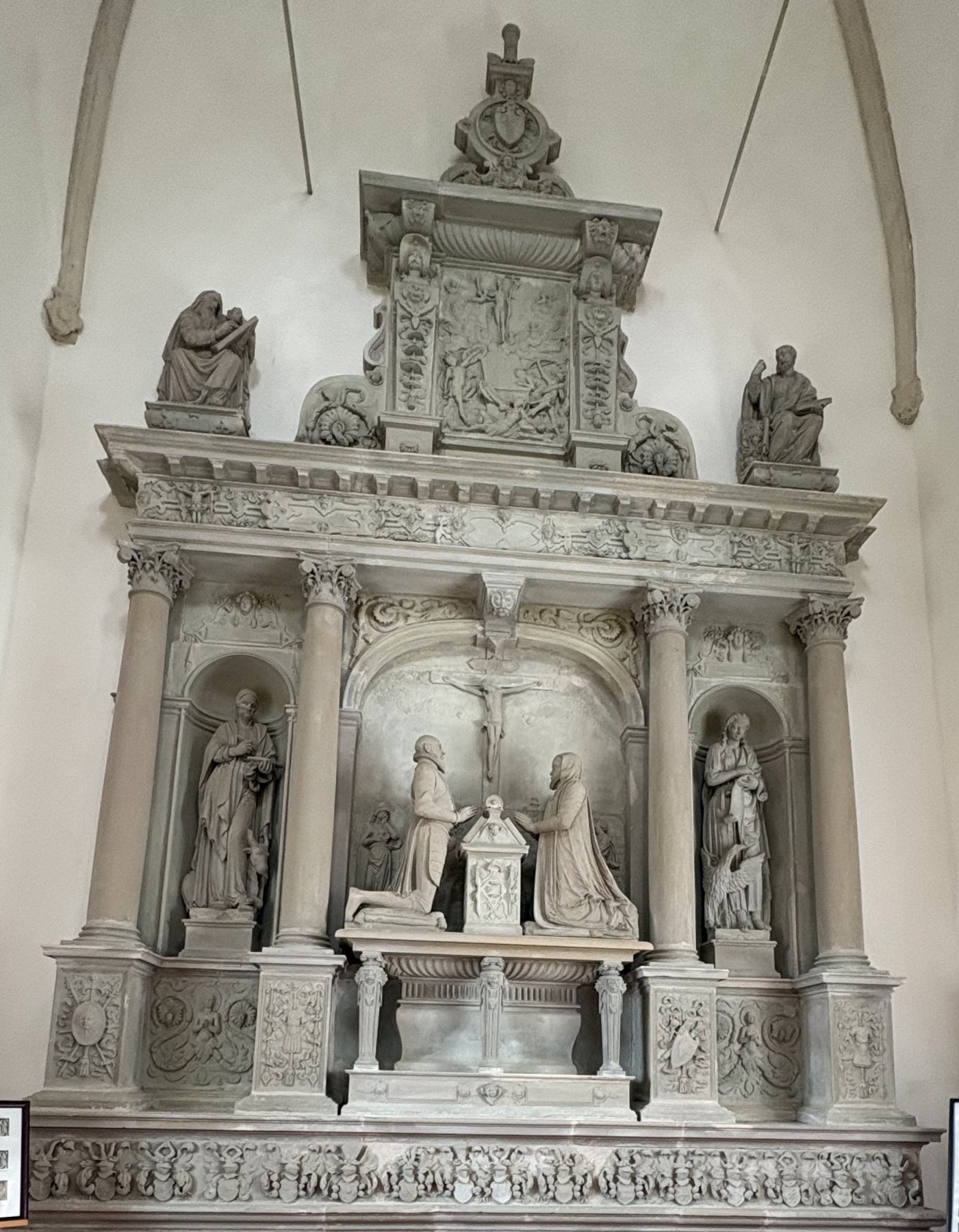
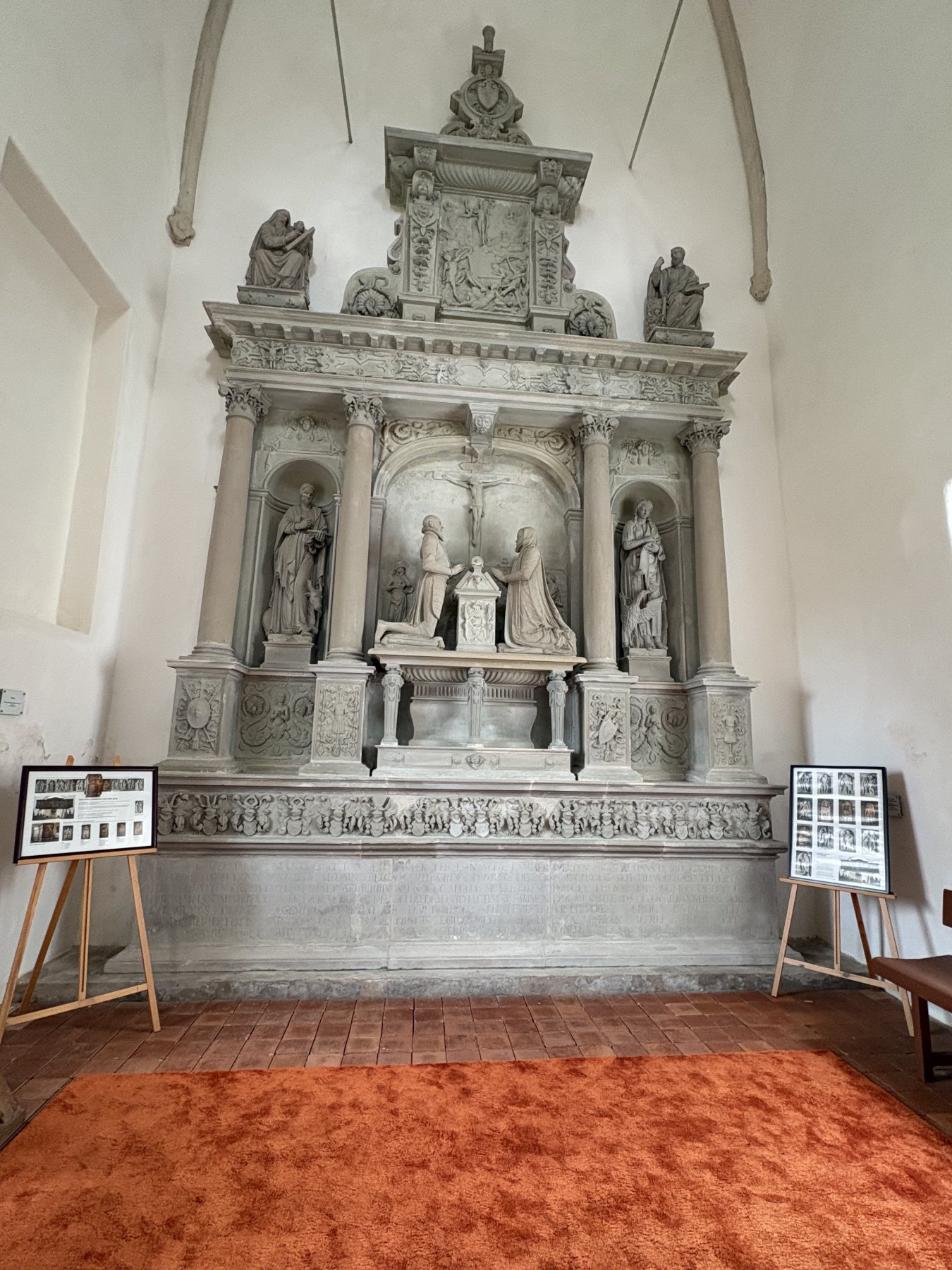
A powerful stone structure, richly ornamented. Christ on the cross. On the left, a kneeling man; on the right, a kneeling woman. This image struck me as strangely familiar. Immediately, I thought of a work of art I had photographed here in North Jutland myself: the tomb monument in the church of Voer, near Voergaard Castle.
But the newspaper photo showed the chapel church in Meisenheim.
I work here in Denmark as a tour guide, and I love exploring the places and stories I bring to life for my guests. In doing so, I want to understand what lies behind what we see: Who created something?
Why here, of all places?
What people, ideas, and connections link these places to one another?
It's important to me to share well-founded knowledge.
So this photograph wouldn't let me go. Suddenly, a connection seemed to open up between my old home and my present one. Was this just a striking similarity? Or could there be a shared history behind it?
At first glance, both works look like magnificent altars. In fact, they are tomb monuments, also called epitaphs. With this first clarification, my small art historical detective work began.
The newspaper article appeared on September 26, 2026, marking the 500th birthday of Duke Wolfgang of Palatinate-Zweibrücken. Under the headline "He didn't just advance the Reformation," the RHEINPFALZ told the story of his life and work. The photo showed the tomb for him and his wife Anna of Hesse in Meisenheim.[1]
It was created by Johann von Trarbach, who ran a significant sculpture workshop in Simmern. The New German Biography dates the work to 1571–1575; the art historical handbook Dehio gives 1575 as the year it was erected. The roughly 6.60-meter-high monument is made of tuff stone and has inscription plaques of slate. At the center, the couple kneels beneath a large crucifix, surrounded by richly ornamented architecture with ancestral coats of arms.[2][3]
The monument in Voer Kirke, by contrast, shows Otte, also Otto, Banner and Ingeborg Skeel. Banner died in 1585, his wife in 1604. Ingeborg Skeel had the burial chapel arranged for her late husband and herself. Danish sources name Philip or Philipp Brandin and Herman Gertsen, also called "Herman Stenhugger," as possible creators of the monument.[4][5]
However, this attribution is not certain. The sources explicitly use cautious language. In my research, I found no unambiguous contract or receipt confirming either of them as the creator.
With the dates, too, careful examination pays off. The frequently cited 1586 is connected to the arrangement or modification of the burial chapel. It is not a reliably documented completion year for the epitaph. In his 1930 study, P. Christensen speculated that the monument must have already been under way if the chapel was erected in 1586: its unusual height seemed to be adapted to its dimensions. This is a comprehensible reasoning from the author, but not documented proof of completion date.[4][6]
By this chronology, Meisenheim is the older work. When it was erected in 1575, Otte Banner was still living. The creation of the Voer tomb monument, by contrast, dates to after his death in 1585. Thus roughly a decade or more lies between the two. Meisenheim could potentially have served as a temporal model. But this sequence alone does not prove it actually was one.
What particularly fascinates me about my two starting images is their overall effect. In both, the man kneels on the left and the woman on the right. Both turn toward the center. Above them appears Christ on the cross. A tall, largely symmetrical architecture encompasses the scene; above it rises another structure, beneath it lies a broad base with inscriptions. It is this interplay that immediately transported me to Voer when I looked at the newspaper.
On closer examination, differences also emerge. In Voer, four round columns articulate the structure. Figures stand in niches on the sides. Between the kneeling couple sits a prayer desk, while the crucifixion appears as a relief in the background along with other figures. In Meisenheim, the large crucifix dominates the center much more directly. Coat-of-arms-decorated pillars frame the scene, and above the kneeling figures are two inscribed tablets.
Not every detail visible today dates from the time of creation. According to Dehio, in Meisenheim the heads and arms of the two main figures were struck off in 1795 and restored in 1896. Whoever compares facial features or hand positions must take these alterations into account. Therefore, my comparison rests primarily on the overall design of the works; I could not undertake a complete restoration history study.[2]
In my search, I encountered further Renaissance epitaphs. Particularly helpful was Andreas Weiner's essay "Late Renaissance Sculptors of Trier." It describes a type of tomb monument that Trarbach developed for the Hohenlohe in Öhringen in the late 1560s and which was taken up multiple times in his workshop and its successors. Mentioned are the monuments for Ludwig Casimir and Anna from 1570 and for Eberhard and Agatha from 1573/74. Meisenheim is explicitly classified as another example.[7]
The epitaph of Albrecht von Esch and Brigitte von Koppenstein in Sehlem, dated to 1575, also shows kneeling figures beneath the cross. The Catherine Altar in Klausen from 1588, by contrast, reminds me of Voer in its architectural structure: four columns, side figure niches, and a smaller relief structure above. The large kneeling couple is absent there, however. Weiner identifies the artist as Conrad Haar and considers earlier work in Trarbach's workshop likely. He does not claim a connection to Voer.[7]
These examples help recognize widespread design ideas. Yet my original observation remained: among the works I examined, Voer and Meisenheim remind me of each other most strongly in their overall effect. This is my personal impression when comparing images, not a definitive art historical judgment.
Another clue led to Mecklenburg and thus to Brandin. He came from Utrecht, is documented in Schwerin in 1563, and established a workshop in Wismar in 1567. For Güstrow Cathedral, his workshop created large tomb monuments. According to a specialist study by the Dutch Institute for Art History RKD, the kneeling figures of Duke Ulrich and Elisabeth were completed in 1585. Later, the figure of the second wife was added. Unlike in Voer and Meisenheim, these people kneel side by side facing the altar.[8]
Basedow also has elaborate epitaphs with kneeling figures, columned architecture, and religious reliefs. Dehio cautiously attributes them to the workshop of Brandin and Claus Midow. Among these are the monument to Bernd XIII of der Schulenburg and Anna Hahn from 1589 and that of Werner Hahn and Anna von der Lühe with their son Hans from 1594. The combination of kneeling figures and monumental architecture was thus present in this artistic milieu as well. Because of their later dates, these works are initially comparison pieces rather than directly models for Voer.[9]
Particularly interesting is that Brandin's activity in Denmark is actually documented. In October 1587, Duke Ulrich recommended him to the Danish king for the renovation of the castle in Nykøbing Falster. On June 19, 1588, he was employed there as master builder. In the years 1589 to 1594, he traveled there repeatedly; he died in Nykøbing in 1594.[5]
Thus there is an actual connection between his Mecklenburg sphere of activity and Danish patrons. For Voer, however, his involvement remains an attribution. By the way, this refers to Nykøbing on Falster in southern Denmark, not Nykøbing Mors at the Limfjord.
Could Brandin and Trarbach have known each other? This question brings up Antwerp.
The New German Biography calls Trarbach's trip there documentary evidence, but names no travel year. The RKD study considers it possible that Brandin worked for a time in the Antwerp workshop of Cornelis Floris. Two documented, temporally comparable stays do not emerge from this. Unfortunately, I could not establish a meeting.[3][8]
The so-called Floris style offers another art historical context. This refers to an ornamental formal language of the Renaissance shaped by Cornelis Floris, featuring, among other things, artfully scrolled band forms. In Trarbach's work, the specialist literature describes such influences and inspirations through printed graphics. In Brandin's case, possible work in Floris's workshop is discussed. This shared background can make related designs more understandable; but it still doesn't explain the concrete similarity of our two tomb monuments.[3][8]
For the transmission of ideas, a personal encounter would not have been necessary. Drawings, models, or traveling workshop members would also be conceivable mediators. For Voer, Christensen considered whether Herman Gertsen could have adopted a model or partially completed work by Brandin, and pointed to a journey Herman made to Güstrow in 1586. This too remains a historical hypothesis. A transmission from Meisenheim is not documented by this.[6]
Finally, I wanted to know whether this comparison was already known. Is Voer mentioned in the literature about Meisenheim, or Meisenheim in descriptions of Voer? In the sources I checked, I found no explicit mutual reference. Of course, this doesn't mean it doesn't exist elsewhere. Not all publications were fully accessible, and archival research or inquiries from local experts have so far not been part of this investigation.
In the course of my small study, I encountered further Renaissance tomb monuments with kneeling figures, crucifixion scenes, and skillfully crafted structures. Yet the similarity between the tomb monuments in Voer and Meisenheim remained particularly striking for me. It was the starting point and remains the core of my question.
Meisenheim is the older work. Whether its design influenced Dänemark, whether artists or workshop members passed on design ideas, or whether both monuments derive from common sources—I could not determine.
What began with a chance glance at the newspaper from my old home has changed the way I see a work of art in my new home. Perhaps specialists will now take up this observation and uncover whether behind this startling similarity lies indeed a previously overlooked connection.
Sources
1. Andrea Dittgen: "He Didn't Just Advance the Reformation," DIE RHEINPFALZ, September 26, 2026, "Your Weekend." Tomb photo: Eric Sayer. Newspaper clipping consulted.
2. Dehio: Meisenheim, Evangelical Palace Chapel.
3. Eberhard Zahn: Johann von Trarbach, New German Biography 10 (1974), pp. 573–574.
4. Frederik Thede: Voer Kirke - Brønderslev Kommune, Lex.
5. Birgitte B. Johannsen / Fr. Weilbach: Philipp Brandin, Danish Biographical Lexicon.
6. P. Christensen: Voergaard. Described Historically and Topographically, Hjørring 1930, especially pp. 112–122.
7. Andreas Weiner: Late Renaissance Sculptors of Trier, Trier Journal 67/68 (2004/05), pp. 283–313, especially pp. 284–290, 295–297, and 310–313. Full PDF consulted.
8. RKD Studies: Netherlandish Sculptors in Mecklenburg, in: Masters of Mobility, Section 4.2.
9. Dehio: Basedow, Evangelical Church.
Further Reading - Bibliographically Identified, Not Fully Consulted
- Wolfgang Schmid: Tomb and Residence—Meisenheim am Glan in the 16th Century. In: Viatori per urbes castraque. Festschrift for Herwig Ebner on His 75th Birthday, Graz 2003, pp. 573–610.
- Wolfgang Schmid: The Tomb of Duke Wolfgang of Palatinate-Zweibrücken († 1569) in the Palace Chapel at Meisenheim—A Work of Sculptor Hans von Trarbach. In: 1504–2004. Palace Chapel Meisenheim, Speyer 2003, pp. 253–286.
- Carsten Neumann: Renaissance Art at the Court of Ulrich of Mecklenburg. Kiel 2009.